How to prepare.
The Sadhana Chatustaya is a way to assess where you currently stand and prepare yourself to attempt conscious living. First expounded by Shankaracharya in the Tattva Bodha, and repeated as a pre-qualifier for studying Upanishads such as the Mandukya, it has many classical interpretations already. What follows is a nuanced reading of the four pre-qualifiers — or, read another way, four steps.
- I
Mumukshutva — the desire for liberation
It all starts with the desire for liberation. Desire cannot be practised; it is triggered by a combination of events. It could be the cycle of misery and happiness that drives one to the edge, from where you start seeking liberation.
- II
Shat Sampat — the six virtues
You progress by stabilising the mind and its associated emotions. Six virtues are to be practised: peace of mind; control of the senses, the sense-withdrawal articulated in Patanjali Yoga; withdrawal to the inner world, desisting from sense enjoyments; toleration of existing conflicts; certainty on the path embarked upon; and intense focus. These virtues overlap, and they are meant to — they all point to one objective, which is a calmer and more detached mind over time.
- III
Vairagya — detachment
A feeling of detachment one attains, which can be read as a measure of success in practising shat-sampat. Scriptures point out that vairagya starts at a base level of decreasing passion for material objects, and that over time you develop detachment at a higher level. Patanjali's Yoga Sutras 1.16: when it is non-thirst for even the gunas, due to the realisation of Purusha, that leads to the supreme form of vairagya.
- IV
Viveka — discernment
Each sutra card on the Philosophy page should show the essays tagged to it, under a heading such as 'Worked through in'. Each essay should carry the reverse link back to its sutra. This turns two static archives into one navigable body of thought and is the main argument for doing the integration properly rather than as an outbound link list.
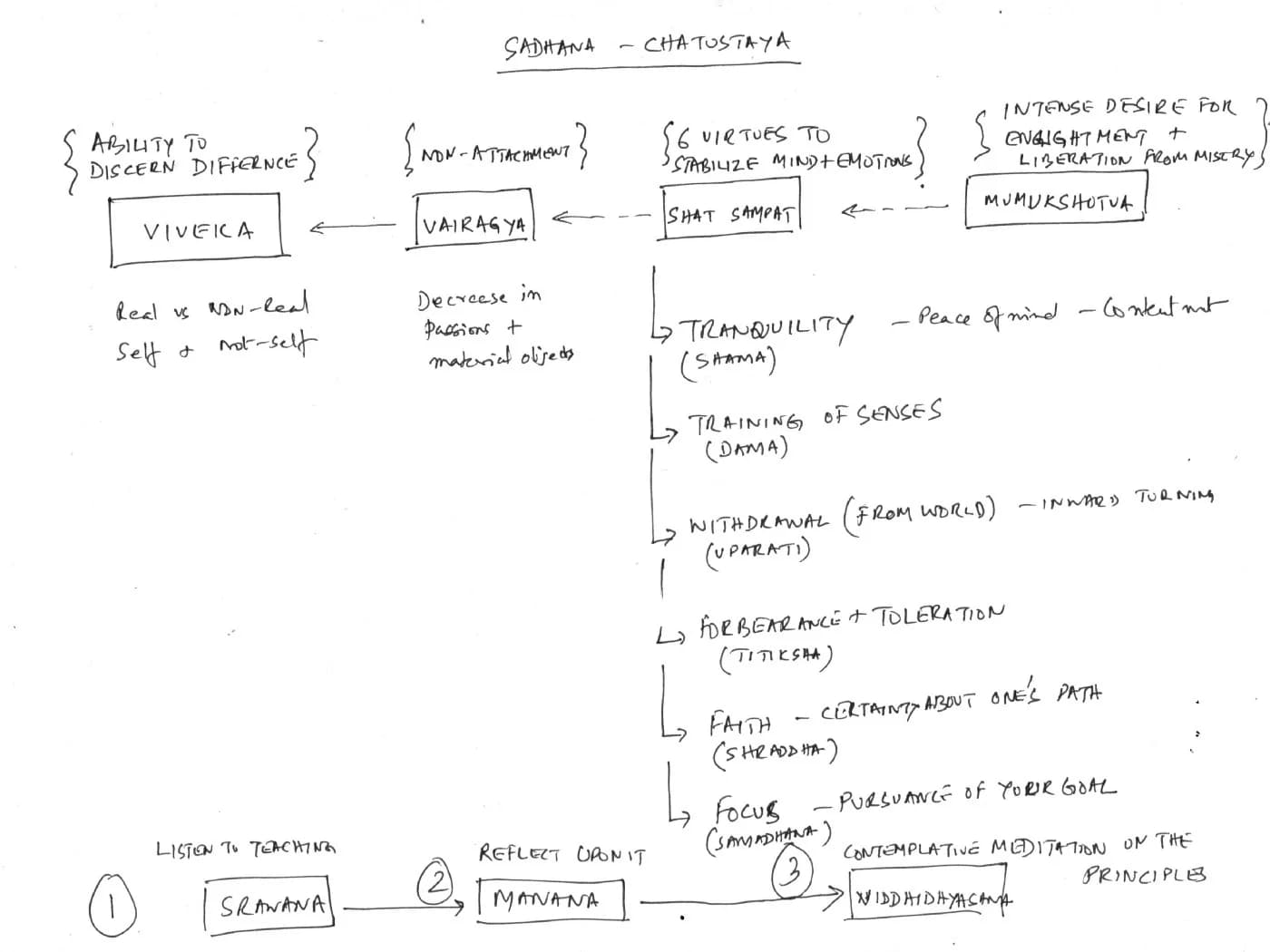
At the foundation: three skills.
Sravana
Deep listening
Manana
Reflection
Viddhi Dhyasana
Contemplative meditation
At the foundation of these four pillars lies the development of three skills — deep listening (Sravana), reflection (Manana) and contemplative meditation (Viddhi Dhyasana). Listening to a guru is far easier, and perhaps more practical, than gleaning insight from aphorisms. Unless one reflects in quiet, it is hard to digest deep insight. Contemplative meditation, we believe, is what permanently etches the learning into memory.