We must exist in the Karmic Plane, bound by different codes of life. We do not have a choice.
Philosophy · Sandip Maiti
Conscious living in a material world.
Living in the karmic plane is our destined reality. Can we navigate our way within?
The Conscious Living Framework is for those seeking the path of spirituality while tethered to the material world. It lets you choose a comfortable starting point, pick one of many available routes offered by different schools of philosophy, and learn from your own experience along the way.
It helps you design your own way to live. It rationalises conflicts and answers bothersome questions by pointing you to source references. It claims no intellectual authority and no rigour sufficient to navigate every possible scenario. The resources point to different gurus and their documented commentaries; collective experience is minimally archived so that those who come after can pick up where others left off.
Turiyo is the fourth state of body-mind existence — beyond waking, dreaming and deep sleep. The village property, the residency and this website all take their name from it.
Turiyo is revealed to only those who seek. The path is never about this ‘or’ that; always this ‘and’ that. Try everything without getting trapped in dogma. In your search for truth, you will find your own answers.
Movement I
Where we are
Sutras 01–03. The Karmic Plane and the equipment we have for it.
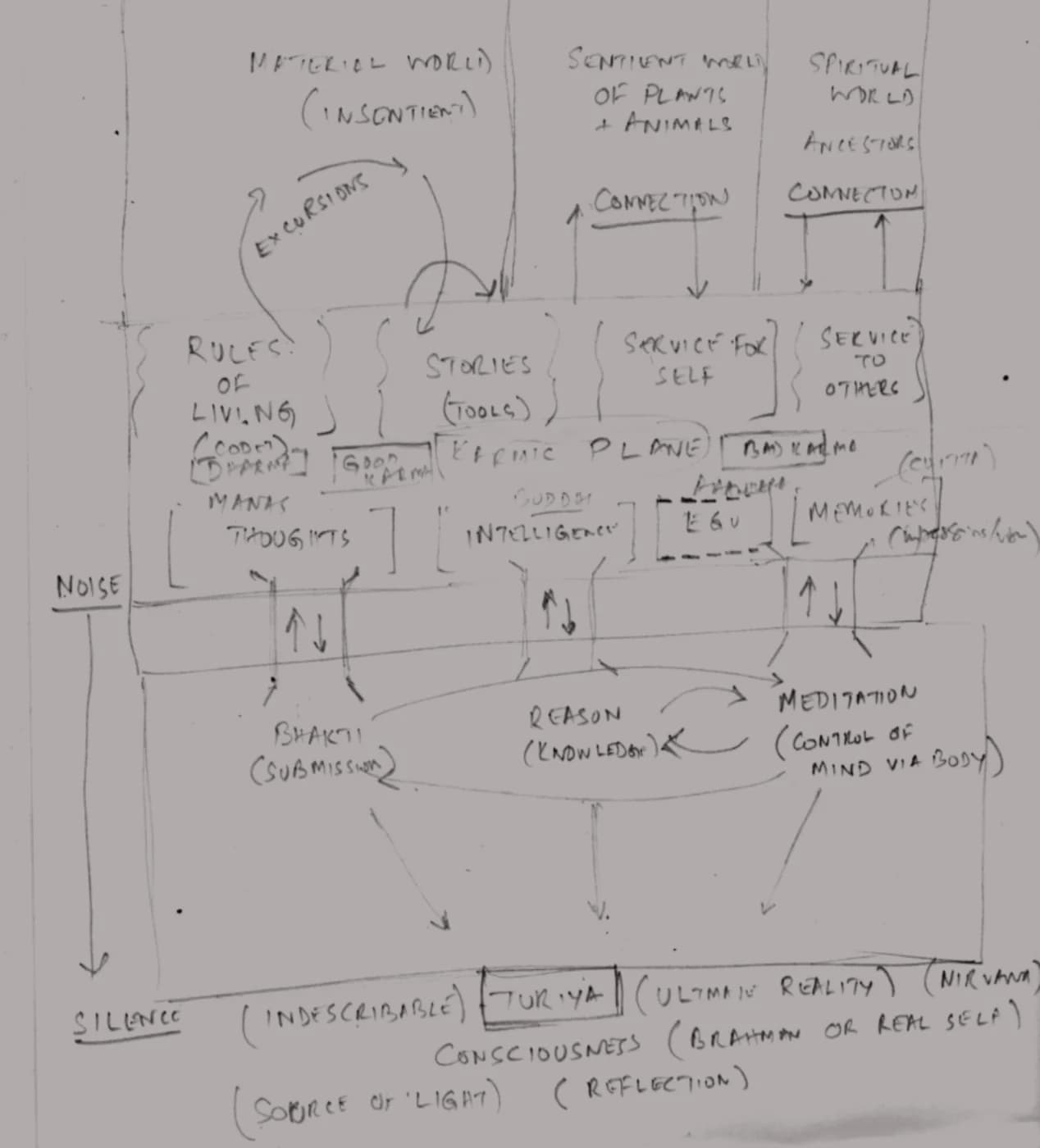
When we are not sleeping or dreaming, we are always making excursions into the material, non-sentient world. For some, these excursions include the sentient world of plants and living beings, and of our ancestors. Not obvious to the lay observer, that sentient world can be accessed by temporarily relaxing the constraints imposed by our rational, scientific minds.
We exist in the Karmic Plane using our physical body and the mind. The body has three states of existence — waking, dreaming and deep sleep. The mind has four virtual chambers that help us interact with the worlds: Thoughts, Intelligence, Memories and Ego.
Movement II
What we navigate by
Sutras 04–05. Codes and stories.
There are certain documented codes of living. We can follow any of these or synthesise our own codebook. The Bhagavad Gita, for example, is an excellent manual of codes with a set of promises; there are similar ones from different communities around the world.
Stories, like codes, are a very important part of our existence in the Karmic Plane. Stories are embedded in our memories, serve to entertain, but most importantly help add comprehensible dimensions to the rather dry codes of life.
Movement III
Action and its consequences
Sutras 06–07. Karma.
As the name Karmic Plane suggests, action — work — forms the bedrock of our existence. There is no running away from action. It is futile to give up on karma for our spiritual quests. However, one could make an effort to shift focus from service for self to serving others.
The intrinsic quality of our actions generates karma, good and bad. There is no direct correlation between action performed and results obtained — good karma need not always deliver a good state of living, and we often find the worst miseries descending on the lives of people accumulating good karma. However, there is evidence that accumulating good karma provides immediate benefits by triggering good thoughts in our minds. There is no getting away from bad karma. If one pushes the needle towards good karma, it establishes a positive cycle, and we soon realise that it is the good mind that is the real game-changer.
Movement IV
The boundary
Sutras 08–09. Consciousness, and why it cannot be described.
The Karmic Plane is bounded by the sentient and non-sentient world on one side, and by the world of consciousness on the other. Our sensorial perceptions and the resulting images in our minds are limited to only the material, sentient and spiritual worlds.
Consciousness cannot be objectified and so there is no way to describe it using words in our current vocabulary. It is not a sensorial experience, nor something that can be imagined. It is not bounded by time or space. The Vedanta school uses a technique of negation — neti-neti, not this, not that — to arrive at a definition. It also holds that the world of consciousness must exist as the seer, because the object world of the body-mind can be seen; it therefore does not exist within our definition of the Karmic Plane. This uni-dimensional world is akin to the idea of singularity in science, and is labelled the ultimate reality, with nuanced definitions such as Atman or Brahman.
Movement V
The three gateways
Sutras 10–11. Bhakti, knowledge, yoga — and why doing all three at once is hard.
There are three channels, or gateways, from the Karmic Plane into the formless and incomprehensible world of consciousness: the path of Bhakti, total submission based on faith and love; the path of Knowledge; and the path of Yoga. Some schools recommend entering sequentially, disciplining the mind first, then gaining knowledge, and finally culminating in total submission. This framework encourages pursuing all three simultaneously. While it has an obvious bias toward the path of knowledge for the educated mind, it believes yoga to be the perfect enabler and bhakti to provide the final leap. These pathways are neatly summarised within the Bhagavad Gita, with copious commentaries spanning three to four millennia.
It is extremely difficult to make excursions in the material world and travel through the three gateways at the same time, in our attempt to synthesise ultimate reality or experience Turiyo — the fourth state of body-mind existence, or consciousness. Most saints shun the material world and avoid stimulating the sensorial system for that very reason. It makes it relatively easier to focus on the spiritual world with a quieter mind.
Movement VI
What gets in the way, and the practice
Sutras 12–17. The obstacles are in the mind, and so is the remedy.
The challenge of pursuing conscious living while existing in the material world has more to do with our mind than our body — specifically the two chambers of thought and ego. We are trapped in the vicious cycle of thoughts, good or bad; emotions, happy or sad; and attitude to life, inspired or dejected. We are also trapped within our ego, which provides the illusion of self.
The way to tackle these challenges is to practise the art of detachment, so we can minimise the chatter of thoughts. That leads to minimising both the intensity and frequency of our cycle of emotions. Consider wrapping the thought chamber with a sheath of detachment.
Detachment can be initiated when you start observing your own mind. To view oneself from a distance — both the thought chamber and the ego — like a character in a game, allows one to monitor emotional states objectively. Meditation helps attenuate the rise and fall of emotions, along with constant feedback to the mind about the illusory nature of emotions.
Minimising the noise in our thought chambers will spur the use of intelligence, buddhi, which is a good thing. Intelligence can power both selfish, material action and selfless service unto others; but if we remain detached, the resulting benefits will be independent of the kind of karma we accumulate.
Ego is important for existence in the Karmic Plane because it spurs action. However, we cannot give it a free handle, because it is also the source of most of our problems. Start the practice of boxing up the ego, so that it sends an alert when it grows in size or attempts to disproportionately influence thoughts and emotions.
Worked through in
Memories get imprinted over time as we pursue karma. It is important to protect and preserve the memories of our ancestors, and to pass them on, along with our own good memories, in the format of stories, to our next of kin.
Movement VII
The journey
Sutras 18–19.
This framework recommends simultaneous pursuit of the three paths. It has been proven over time that the spheres of bhakti and knowledge, or yoga and knowledge, reinforce each other. The relative proportions depend on what appeals to the individual in pursuit of truth.
But that was circa 700 CE. What works now is best left open to experience, and built upon.
Worked through in
Turiyo represents attaining the state of consciousness, where all other forms of existence cease to be. It is like merging oneself and the entire karmic existence within an unbounded space where there is the absolute silence of thoughts, absence of ego, and cessation of all material pursuits.
Nothing here is new.
There is nothing new in the framework above, barring some terminology. The ability to traverse from the material world through the karmic plane to the world of consciousness, and back, has been demonstrated by monks like Shankaracharya and Vivekananda, among many others. Everyone had their own path that worked in their own space and time.
Shankaracharya followed the path of Advaita Vedanta but surrendered to the idea of a personal god. One only needs to look at his vast body of scholarly work — rather jaw-dropping — and consider that it came in the midst of extensive travel and the founding of institutions like the Sringeri Math. Clearly he was existing in the Karmic Plane, in spite of having reached the highest altars of realising the state of Turiyo.
But that was circa 700 CE. What works now is best left open to experience, and built upon.
Come and spend some quiet time reflecting on the path you have chosen, and share your journey with others.